3rd Yiddish Festival in Birobidzhan

3rd Yiddish Festival in Birobidzhan

3rd Yiddish Festival in Birobidzhan

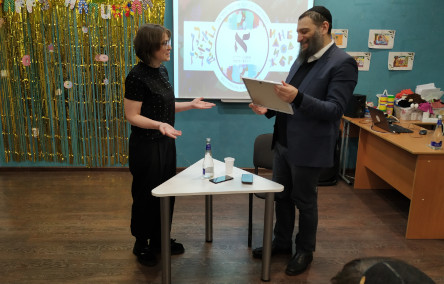
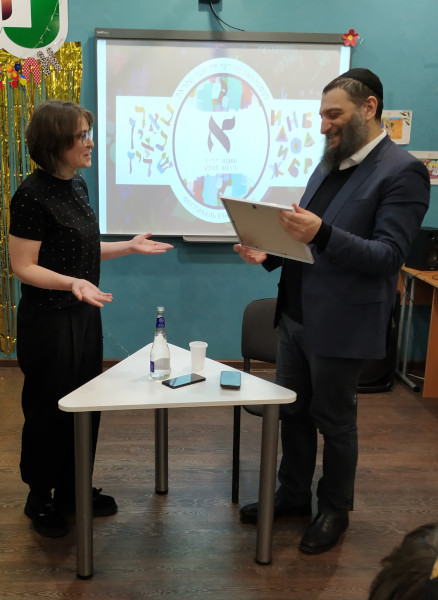
From December 4 to 7, 2023, the 3rd annual Yiddish Festival was held in Birobidzhan. More than 80 events — concerts, workshops, talks with language experts, etc. — were held in the city and several other localities of the region.The program was concluded by the lighting of the first Hanukkah candle and a festive concert. Yoel Matveyev, a Yiddish writer from St. Petersburg, participated in the festival as an honored guest, giving lectures on the spiritual and historical significance of the Jewish Autonomous Region. The festival was attended by Boruch Gorin, director of the Moscow publishing house Knizhniki, who told the Birobidzhan residents about the role of Yiddish in his life and family.

Elena Sarashevskaya, the editor-in-chief of the newspaper Birobidzhaner Stern, interviews Yoel Matveyev at the Yiddish Festival. The conversation was held at the publishing house Birobidzhan.

Modern-ish and Yonia Fain’s Yiddishland

Modern-ish and Yonia Fain’s Yiddishland

Modern-ish and Yonia Fain’s Yiddishland

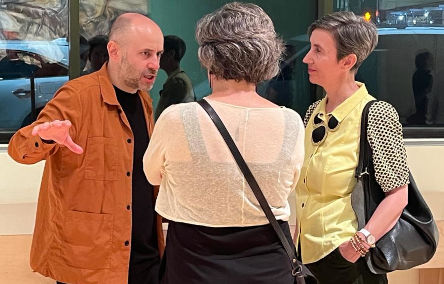
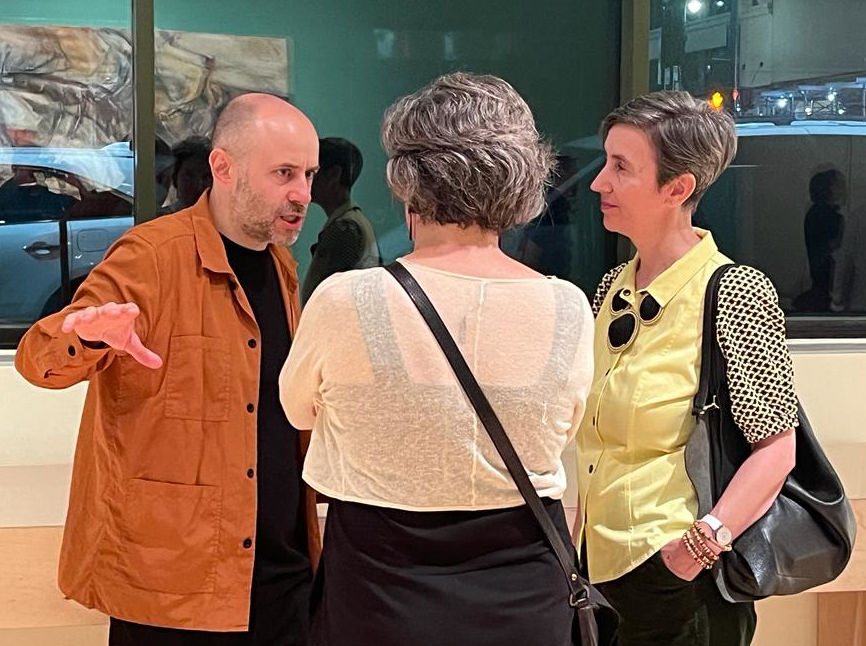
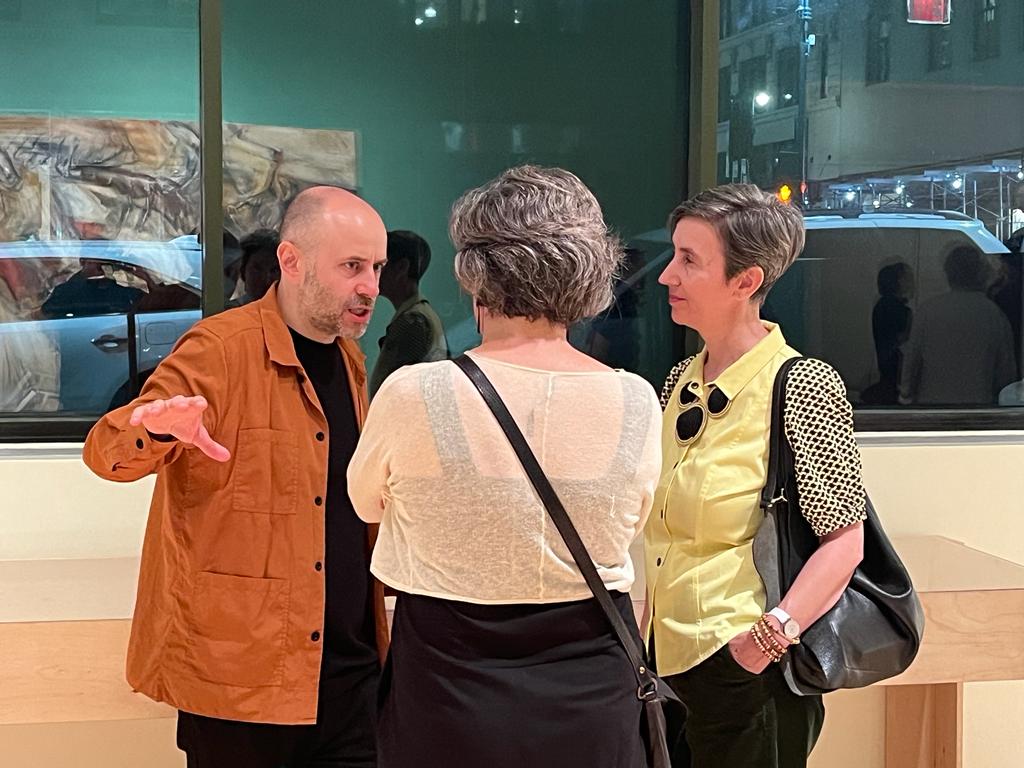
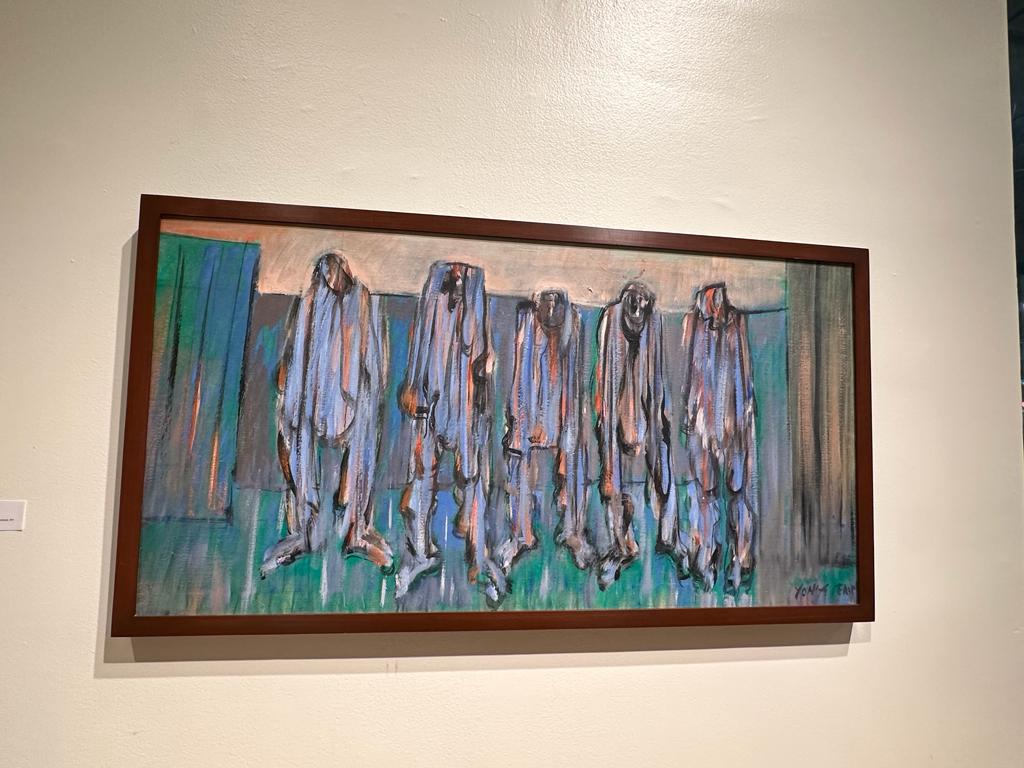
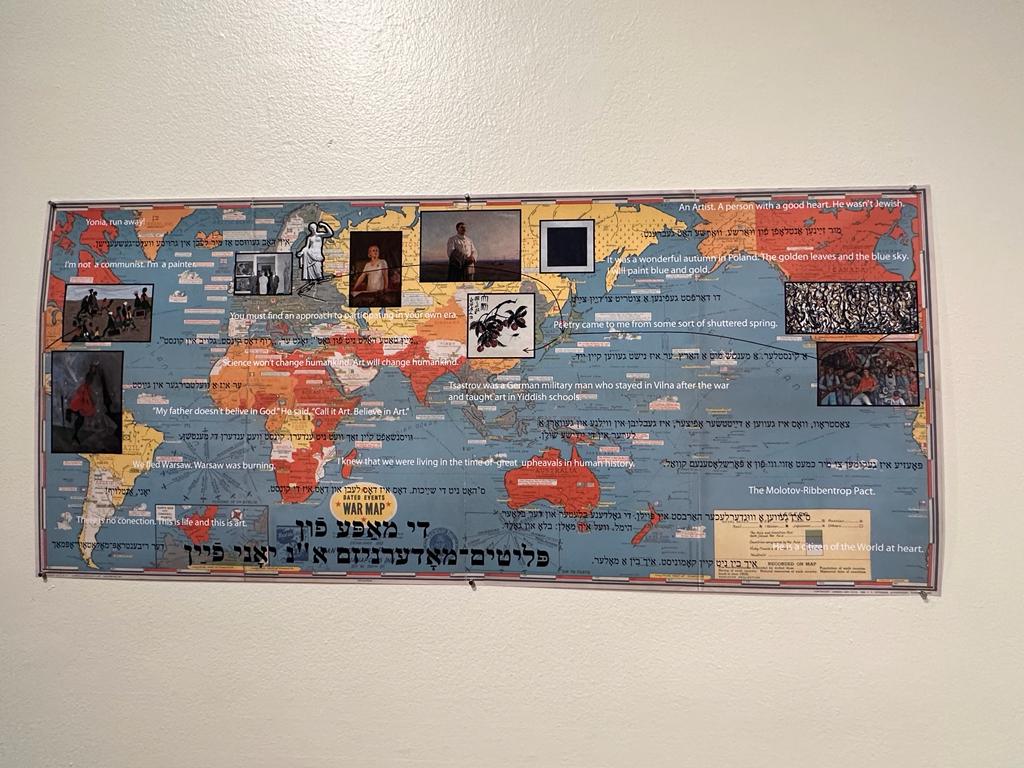
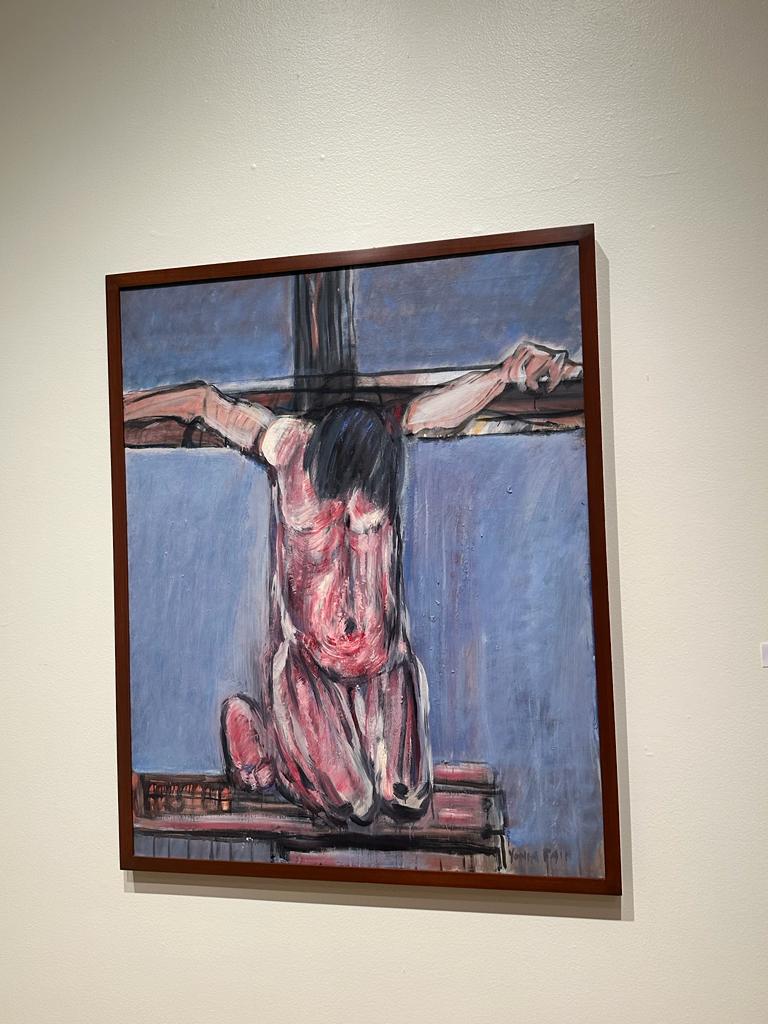
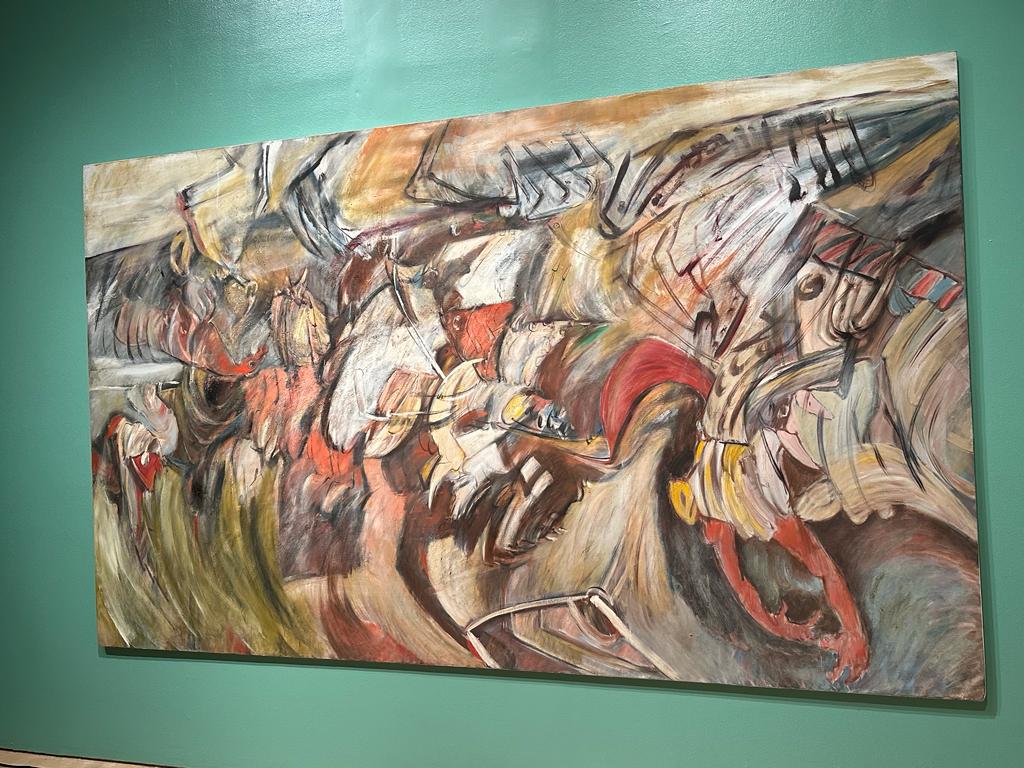
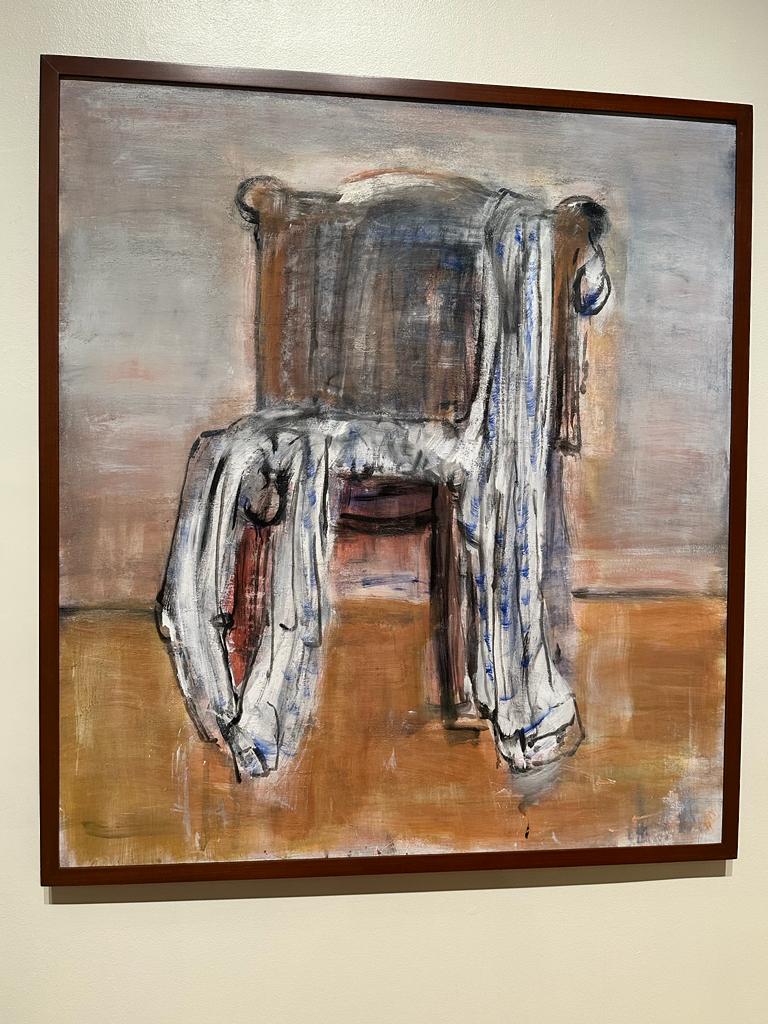
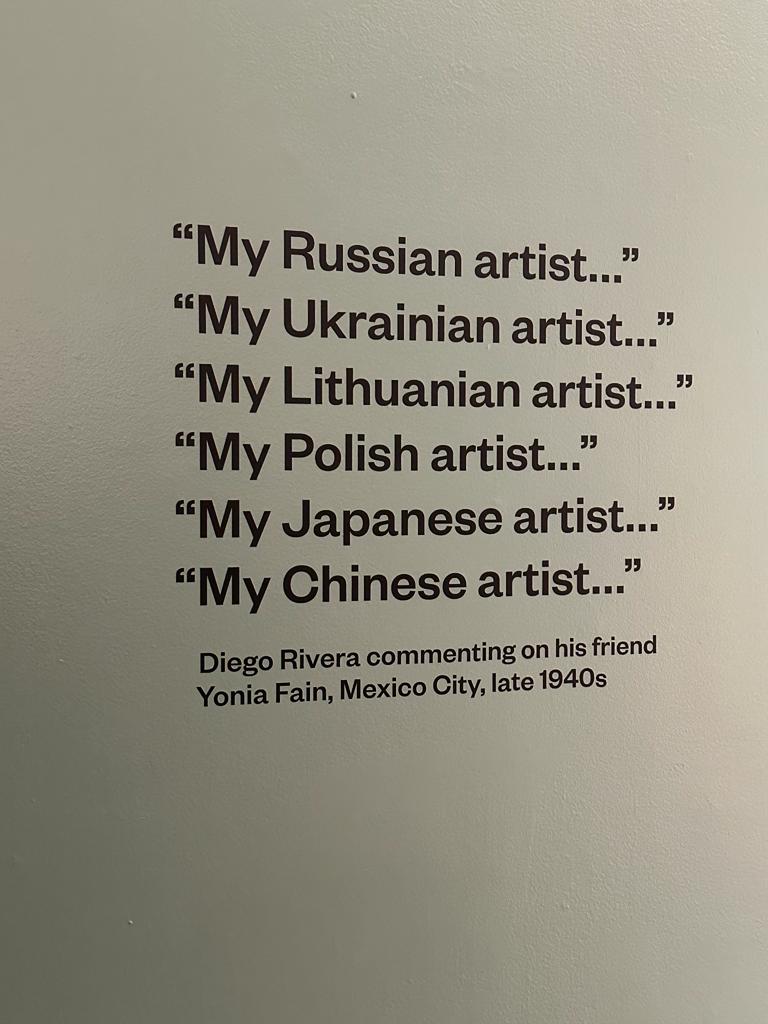
On September 13, 2023, an exhibition called Modern-ish: Yonia Fain and the Art History of Yiddishland by the contemporary artist Yevgeniy Fiks opened at CUNY’s James Gallery, as a part of his project Yiddishland Museum of Modern Art.

Yonia Fain (1913-2013) was a renowned modernist artist and a Yiddish poet, author of 5 poetry books published in that language. During his life he travelled across the entire globe: from Ukraine and Lithuania to Japan, China and Mexico. Fiks told our website that his neologism “Modern-ish” refers to the special modernist tradition of Yiddishland, the global space of Yiddish culture, which does not quite fit into the canons of modernism. Representatives of this tradition often have multiple hyphenated identities: for example, one may be Lithuanian-Jewish-American.

We have already written on our website about Yevgeniy Fiks and his concept of Yiddish as a “cosmic” language, a cultural bridge capable of uniting traditional ethnicity with the principle of universalism, the local with the cosmopolitan and cosmic. In 2022, the Yiddishland pavilion, organized by Fiks, opened at the Venice Biennale. The current exhibition at CUNY will be open until December 9.

Yiddish at Tel Aviv University

Yiddish at Tel Aviv University

Yiddish at Tel Aviv University

Goldrich Family Institute

Yiddish Culture: Practical Engagement

International Summer Program

Yiddish and Yiddish culture are studied at Tel Aviv University on a permanent basis during the entire academic year at the Jona Goldrich Institute for Yiddish Language, Literature and Culture, as well as at the Naomi Prawer Kadar International Yiddish Summer Program.

We are very excited to announce Tel Aviv University’s new program, Interdisciplinary Studies in Yiddish Culture and Heritage, partnered with the Yiddish Heritage Preservation Foundation (Israel). This project will be based on students’ work, guided by the university’s faculty, on various aspects of Yiddish culture, including studies of unique materials published on this website.

Starting from the next academic year (2023-2024), this research will be supported by the Rosa Lubin Scholarship program, created by Dr. Mark Zilberquit, the founder of the Yiddish Heritage Preservation Foundation and of our website. Scholarships will be awarded for archival, historical and other studies of Yiddish culture in its various aspects, including theater, music, film and visual arts. Follow the links above for more information, published on this site with the permission of Tel Aviv University.

Yiddish Civilisation

Yiddish Civilisation

Yiddish Civilisation

Yiddish Culture

Yiddish language

Yiddish and Yiddishkeit

Yiddish and Hebrew

Yiddish and World Culture

Our Mission

Yiddish and Yiddishkeit

Yiddish and Yiddishkeit

There are two related words in Yiddish: “yiddishkayt” (often spelled in English as “yiddishkeit”), which literally means Jewishness as a tradition and culture, and “yidntum”, which means Jewry, the Jewish people considered collectively. While English allows us to preserve the difference between these two terms, they are conflated in some other languages, including the Hebrew word “yahadut” and the Russian word “yevreystvo”.

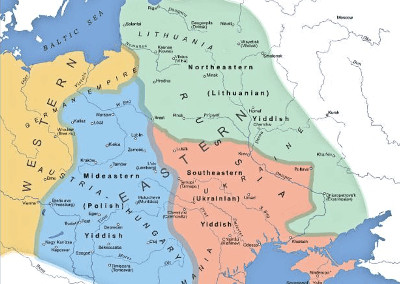
Yiddishland

(YIVO Encyclopedia of Jews in Eastern Europe)

At the same time, the word “yidishkayt” also appears in modern Hebrew and successfully competes with “yahadut”, when it comes to informal, sincere attitudes of Jews towards Judaism, not necessarily linked to official religious structures. In English and Russian this word is also situationally used in the same sense. In the original language – Yiddish – it is simply a derivation of the word “Jew”. However, when used in other languages, it expresses the organic connection between Yiddish and Yiddishkeit, which literally catches the eye.

In the Ashkenazi version of Judaism, the Yiddish language itself has become, without exaggeration, an important element of religious life. The older Jews who acted as the guardians of the Jewish tradition a few decades ago were native Yiddish speakers and used Yiddish terms, even when they spoke a foreign language, to express most concepts related to the traditional Jewish life – from holidays to cuisine. 

New generations of Jews who grew up in the countries where the families had emigrated, or in the ruins of the original Yiddishland, rapidly became assimilated to the surrounding cultures and became secularized. Yet, Yiddish remained for them associated with the old traditions of the ancestors.

Yiddish now plays an exceptionally important role in the ultra-Orthodox religious Jewish communities of the United States, Israel and some other countries, where it remains the main language of everyday communication. 

This role is multifaceted. First of all, Yiddish in such communities preserves the living continuity of the old Jewish tradition that flourished until recently in Eastern Europe. Secondly, it also preserves the traditional internal bilingualism that existed in Jewish communities for centuries, where Yiddish was the Jewish language of daily life, while Hebrew was the language of Jewish religion and sacred texts. 

In religious Jewish terminology, it is about the division between holiness (koydesh) and everyday’s mundanity (khol). Finally, Yiddish maintains the separation of its speakers from the rest of the world, including secular and modernized religious Jews who switched to non-Jewish languages or to modern Hebrew. This separation naturally prevents the Yiddish speakers from becoming modernized. It’s worth to note that from the viewpoint of the ultra-Orthodox Yiddish speakers modern Hebrew is also perceived as a secularized, profane form of the sacred language artificially constructed by the Zionists.

Even in those ultra-Orthodox communities, where most members have switched to non-Jewish languages or Hebrew in their daily life, proficiency in Yiddish is considered prestigious. Yiddish is still taught in yeshivas by some reputable rabbis. A number of works of prominent rabbis who lived quite recently were written and published in Yiddish. Isolated Yiddish words are commonly found in the commentaries to religious texts written in Hebrew by the rabbis of older generations. Such texts, together with the commentaries, are still studied today. One notable example is the popular halakhic work Mishnah Brura by Rabbi Yisrael-Meyer Kagan (1838–1933) known as Chofetz Chaim (and who, by the way, authored several tracts entirely in Yiddish). Various religiously-themed Yiddish folk songs remain popular – and their popularity is not limited to ultra-Orthodox Jews. It is not surprising that those who wish to join an ultra-Orthodox religious community – especially a Yiddish-speaking one – actively study the language. 

Yiddish-speaking ultra-Orthodox Jews have created their own Yiddish press and literature. Yiddish readers outside of those communities are familiar with the American Hasidic writer and blogger whose pen name is Katle-Kanye (meaning “a simple man” in Talmudic Aramaic). 

At the same time, the ultra-Orthodox Yiddish speakers tend to ignore the entire modern and secular Yiddish culture that has already been flourishing for 150 years. Their Yiddish literature and press retains archaic non-standardized forms of spelling and purely dialectal grammatical forms. Moreover, it is infused with borrowed English words absent in literary Yiddish. This peculiar form of the language is often called “Hasidic Yiddish”, because the ultra-Orthodox Yiddish literature and media is dominated by certain groups of Hasidim. 

Despite these oddities, cultural activities of the ultra-Orthodox attracted a growing interest among secular Yiddish enthusiasts in the recent years. After all, thanks to these communities, Yiddish continues to live as a natural spoken language and, contrary to popular belief, is not in immediate danger of extinction.

Some young folks who grew up in ultra-Orthodox communities and for whom Yiddish is their native language, became actively engaged in the treasures of the modern Yiddish culture. Quite a few contemporary secular Yiddish authors and activists have an ultra-Orthodox background. Examples include the Israeli actor Mendy Cahan (born in 1965 in Antwerp); the bilingual English and Yiddish American poet Yermiyohu-Aron Taub (born in 1967 in Philadelphia); the bilingual Hebrew and Yiddish Israeli poet Avisholom fun Shiloakh (born in 1991 in Bnei Brak).
Yiddish and Hebrew

Yiddish and Hebrew

Unlike most other peoples, traditional Jewish communities were for many centuries characterized by internal bilingualism: two languages coexisted in the same community fulfilling different functions. In all Jewish groups, Hebrew was considered the “high” language of sacred texts and worship. As such, it enjoyed high prestige as loshn-koydesh, the holy tongue, as it is called in Yiddish. 

For more than a millennium and a half, the Hebrew language was also the main vehicle of “high” literary genres, such as philosophy, theology and mysticism. Modern secular literature, created according to European models of that time, only appeared in Hebrew at the end of the 18th century, as a direct result of the Haskalah, the Jewish version of the European Enlightenment.

At the same time, every Jewish group in its daily life spoke another language, related to the language of the country where they lived or once used to live. However, unlike their non-Jewish neighbors, they would write their vernacular language using the Hebrew alphabet. For a millennium, the vernacular of the Ashkenazi Jews was Yiddish. 

Besides being the means of daily communication, it was also the language of their folklore and so-called “low” literary genres. In theory, all Jewish men were expected to master Hebrew at least to some degree for religious purposes. Since women were not obligated to learn the “sacred tongue”, early Yiddish literature often appeared in the guise of supposedly women’s literature.

The Hasidic movement that arose in the first half of the 18th century greatly contributed to the development of Yiddish literature. Appealing to simple and unlearned Jews who were poorly versed in the “sacred” Hebrew, Hasidic leaders spoke in Yiddish, themselves cherished this language as a millennial folk treasure, composed prayers and religious songs in that language. Later, in the early 19th century, the Hasidim even developed theological theories, according to which Yiddish had a sacred or semi-sacred status of its own.

At the same time, the Haskalah had a negative attitude towards Yiddish, considering it a corrupt form of German or a Jewish-German jargon. In Germany, Austria, Czechia, Hungary, this movement succeeded to replace Yiddish by German in the everyday life of most local Jews. However, in Galicia, where the adherents of Haskalah had to confront the Hasidim, they had to take the path of creating their own literature in Yiddish for their propaganda purposes. This led to the creation of a full-fledged modern Yiddish literature, which became an organic part of the modern Jewish literature in general, be it written in Hebrew, Yiddish, Russian or German. Paradoxically, despite their disdain towards Yiddish, the Enlightenment writers created the earliest forms of modern Yiddish literature matching the genres of the major European literary traditions of that time.

Many Jewish writers of the 19th and early 20th century, and occasionally later on, were bilingual. For example, Mendele Moykher-Sforim (1836-1917) and Yitskhok-Leybush Peretz (1852-1915) wrote in both Yiddish and Hebrew. Sholem Aleichem (1859-1915), who became a symbol of Yiddish literature, wrote only some of his works in Hebrew, but still knew the “sacred tongue” very well. Chaim-Nahman Bialik (1873–1934), the classic of modern Hebrew poetry, wrote in Yiddish as well and made an enormous contribution to overcoming the stereotype that Yiddish is a “low language”. Shmuel-Yosef Agnon, the only Hebrew writer so far to win the Nobel Prize in Literature, also wrote some Yiddish stories.

Two mutually exclusive cultural and socio-linguistic ideologies emerged and clashed at the end of the 19th century: Yiddishism and Hebraism. Yiddishism, which placed Yiddish, the language of the daily life of millions of Jews at the center of the Jewish national revival, seemed realistic and pragmatic. Hebraism, on the other hand, offered the seemingly unrealistic and utopian goal of reviving a language that always retained its religious functions, but had not been used in daily conversation for at least fifteen centuries. Fierce disputes between the proponents of these two ideologies were humoristically depicted in Sholem Aleichem’s story “Yiddishists and Hebraists”.

Sholem Aleichem himself was a supporter of the traditional Jewish internal bilingualism. In the preface to the first volume of his works, published in 1911, he wrote the following: “Congratulate me! (…) There are twins in my womb. These twins (…) are our languages, Hebrew and Yiddish. (…) People wage war with their neighbors over them, shed ink like water and waste a lot of paper, ask again and again the most serious question: which of our two languages is more deserving the title of the ‘national language’?”

Sholem Aleichem chooses the third option: “Our people is the strangest of all the peoples in the world. It has been living in exile for two thousand years, cut off from the soil, wandering from country to country and from state to state (…) – and it is fitting for it to have two languages at the same time (…). Thus I believe that we must accept both languages with love.”

However, due to the radicalization of both Yiddishists and Hebraists, this traditional Jewish bilingualism with its organic bilingual and even multilingual creativity, fell apart after the First World War. Yiddish and Hebrew literature departed from each other. In the second half of the 20th century, it became obvious that the Yiddishist model of national revival, which earlier seemed realistic, failed against the once seemingly utopian and now victorious Hebraism.

Yet, modern Israeli Hebrew is so thoroughly influenced by Yiddish in its phonetics, phraseology, syntax and vocabulary that one Israeli linguist, Professor Ghil’ad Zuckermann asserts that the Israeli language, as he calls the modern Israeli Hebrew, is a descendant of two equally involved parents: the original classic Hebrew and Yiddish. 

Yiddish itself is thoroughly permeated with words and idioms borrowed from Hebrew and from the closely related Aramaic. Thus, as Sholem Aleichem wrote in the aforementioned preface: “both of these languages borrow treasures from their twin brother.” The prominent American Jewish linguist Uriel Weinreich (1926–1967) even argued, and for good reasons, that “the boundary between Yiddish and Hebrew is not always clear and stable.”

It is certain that none of the other Jewish diasporal vernacular languages of the modern era can be compared with Yiddish in its influence on Jewish culture in general, including the modern Hebrew. Perhaps, the degree of influence of Yiddish on Jewish culture can be compared to that of Aramaic, which was the main Jewish vernacular from the late antiquity till the early Middle Ages, and remains the main language of Talmudic literature.