Monument Sholom-Aleichem

Sholem Aleichem

Monument and Prize
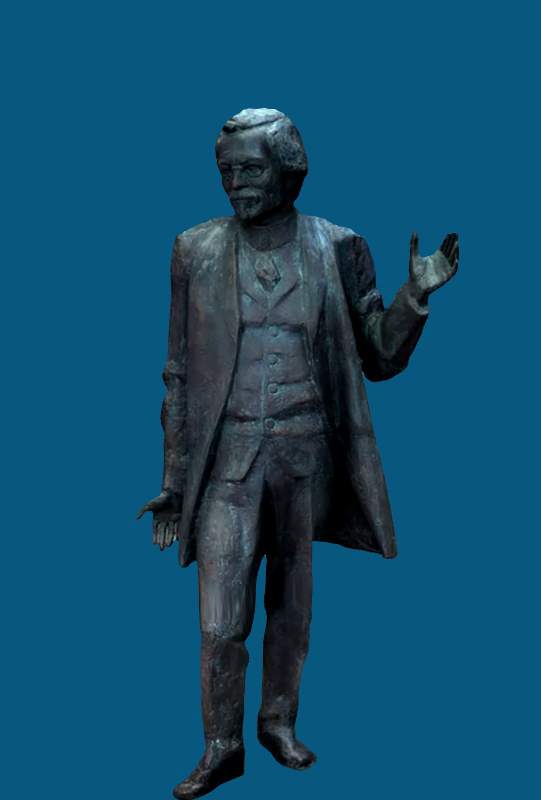
There are solid reasons to believe that Sholem Aleichem, our Yiddish classic writer, deserves far more attention than he has received. His collected works were never published in a full academic edition; his archives were never systematically researched and catalogued. Even his comprehensive and accurate biography has not been written yet. By his efforts, Dr. Mark Zilberquit, a public figure and a publisher, hopes to initiate the complex and long process of filling these gaps.

Two charity foundations established and led by Dr. Zilberquit, the Heritage Projects Foundation (USA) and the Yiddish Culture Preservation Foundation (Israel), in cooperation with the Tel Aviv University (TAU), are currently working on two relatively short-term projects that will, hopefully, signal the beginning of taking Sholom Aleichem’s name to a new level. A monument dedicated to this great writer is planned to be erected on the university’s premises, and an international literary prize named after him is to be established.

The Monument

According to the plan, the campus of the Tel Aviv University is going to be adorned by a replica of Sholem Aleichem’s statue created by Yuri Chernov (original family name Opendak), a renowned Russian sculptor of Jewish background. The original sculpture is located in the historical Jewish quarter of Moscow, near the old Polyakov Synagogue (now remodeled and known as the Bolshaya Bronnaya Synagogue) and the former building of the GOSET Theater, where plays based on Sholem Aleichem’s works, directed by Solomon Mikhoels, were staged up until the theater’s closure in 1948. 

Choosing the Tel Aviv University is not a coincidence. It is home to the Jona Goldrich Institute for Yiddish Language, Literature and Culture, and of the Museum of the Jewish People (ANU), where a unique archive related to Solomon Mikhoels (The Zuskin Collection) is stored.

Erecting a monument of Sholem Aleichem may be viewed as a kind of epigraph to our entire project of preserving the Yiddish culture and paying, at the same time, a tribute to its past. As for now, TAU is certainly one of the main modern research centers of Yiddish literature in the world. The university has regular language courses and organizes annual Yiddish festivals, which include conferences, lectures and concerts gathering thousands of participants.

This monument should become a dominant symbol of the entire complex dedicated to the Jewish and Yiddish tradition – from its past to its ongoing development. It should be viewed not just as a physical bronze-made tribute to the great writer, but as a symbol of his eternal memory, of his works, as a starting point of organization and expansion of educational, scientific and literary programs and awards, which may include scholarships for students of various levels (from bachelor to PhD programs), who dedicate their studies to Sholem Aleichem’s legacy and to other Yiddish writers, as well as for authors of new original Yiddish works.

Sholem Aleichem Prize

Besides scholarships and grants, we are planning to establish an international literary prize named after Sholem Aleichem. This award will be given for achievements in writing Yiddish texts belonging to three separate nomination fields: original literary works, series of journalist articles and literary studies. For this purpose, we are planning to organize special juries at the Tel Aviv University.
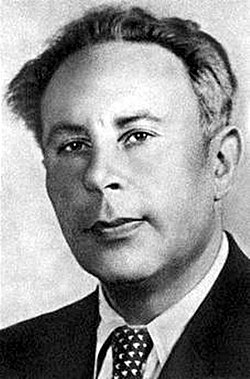
Leyb Kvitko

Leyb (Lev) Kvitko

The Alphabet (book),

lifetime edition

Destruction of JAC

Among the prominent Jewish intelligentsia figures who were executed by Stalin as members of the Jewish Anti-Fascist Committee (JAC), Leyb (Lev) Kvitko (1890-1952) occupies a unique place. Hersh (Hirsh) Remenik, a renowned Jewish and Yiddish literary critic, described Kvitko’s work as follows (by “Jewish writers” Remenik meant those who wrote in Yiddish):

“Of all the Jewish writers, Leyb Kvitko is perhaps the best known to the general Soviet readership and in the entire Soviet literature. This fame came to him mainly because of his children’s poems (…) 

Of course, Jewish Soviet poetry may feel proud of the fact that it has given the general literature such a great artist. But this fame and recognition of Kvitko’s talent as a children’s poet also has a downside: while praising Kvitko as a children’s poet, his readers often forget that his mastery is not limited to children’s poetry (…)

Truth to be told, Kvitko appeared as a literary figure primarily as a great artist of folk literature rather than a children’s poet. Of course, this includes children’s literature as well, but not limited to and by it… “

Archive: Sholem Aleichem

Archive.

Sholem Aleichem

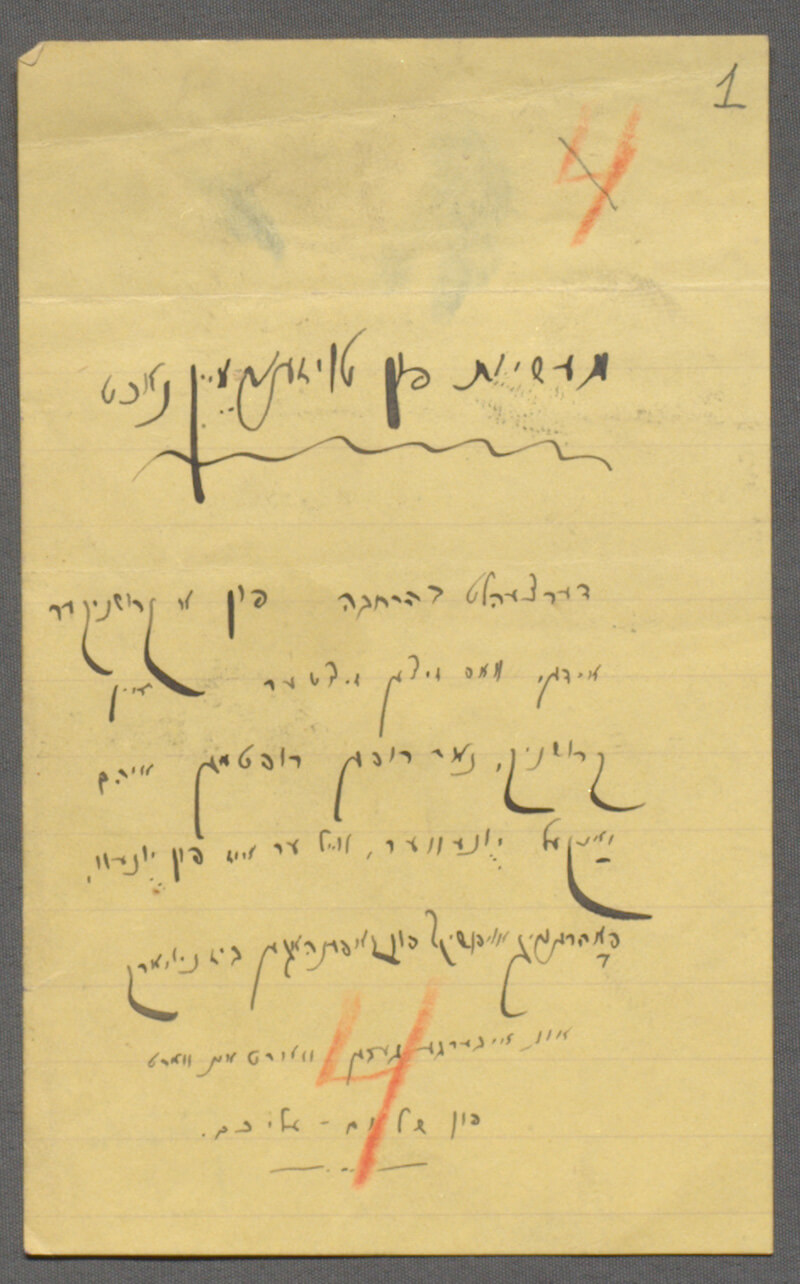
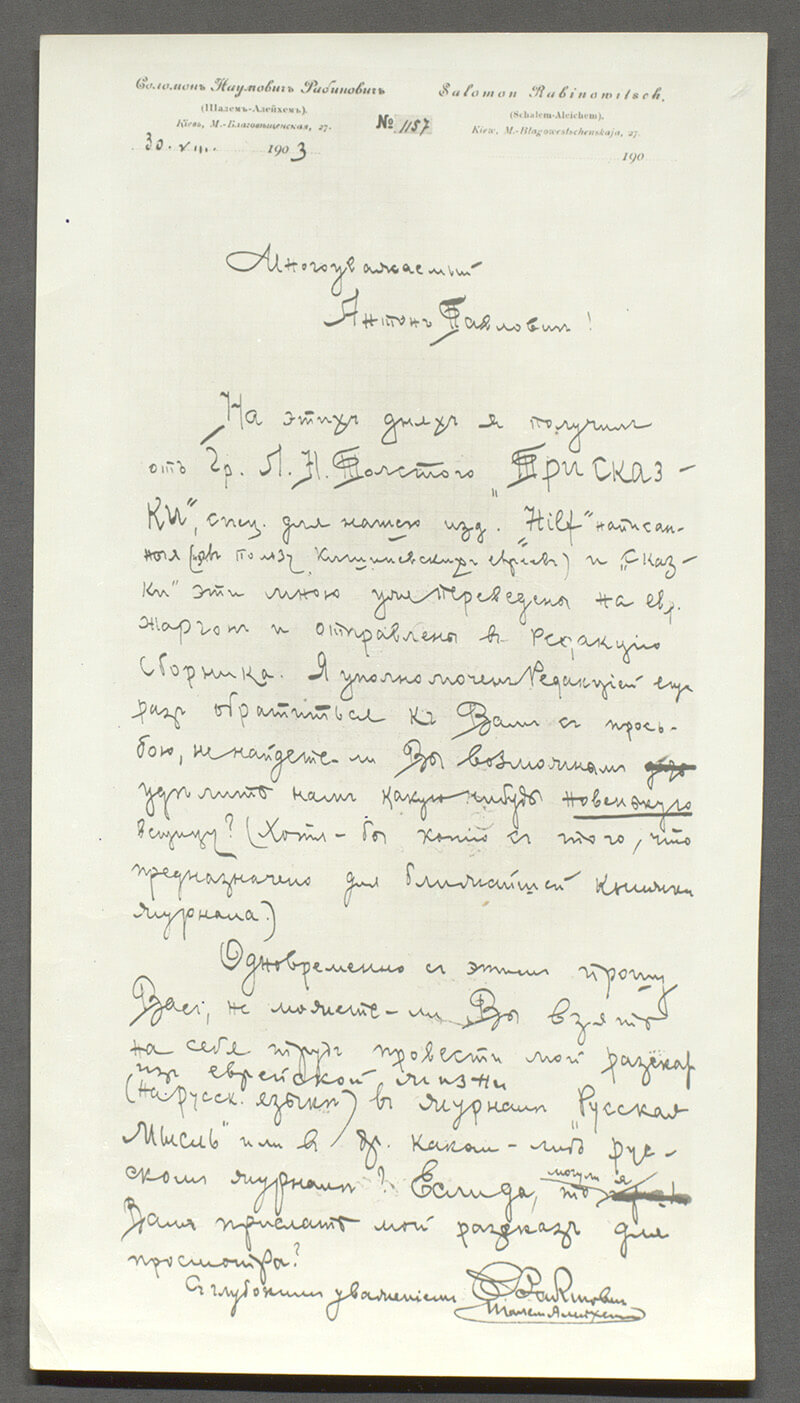
1196-1-23: Letter to Anton Chekhov (Aug. 30, 1903)

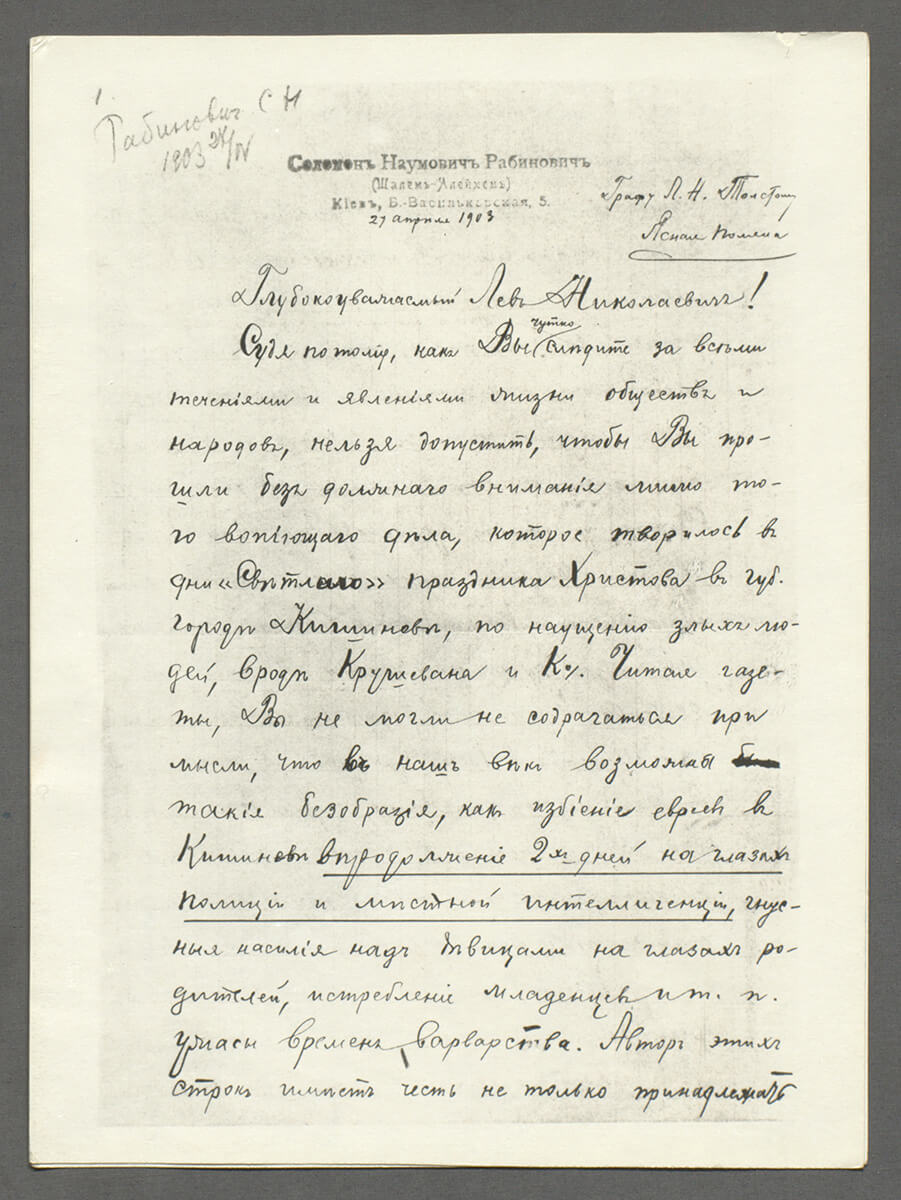
1196-1-22: Letter to Leo Tolstoy (Apr. 27, 1903)

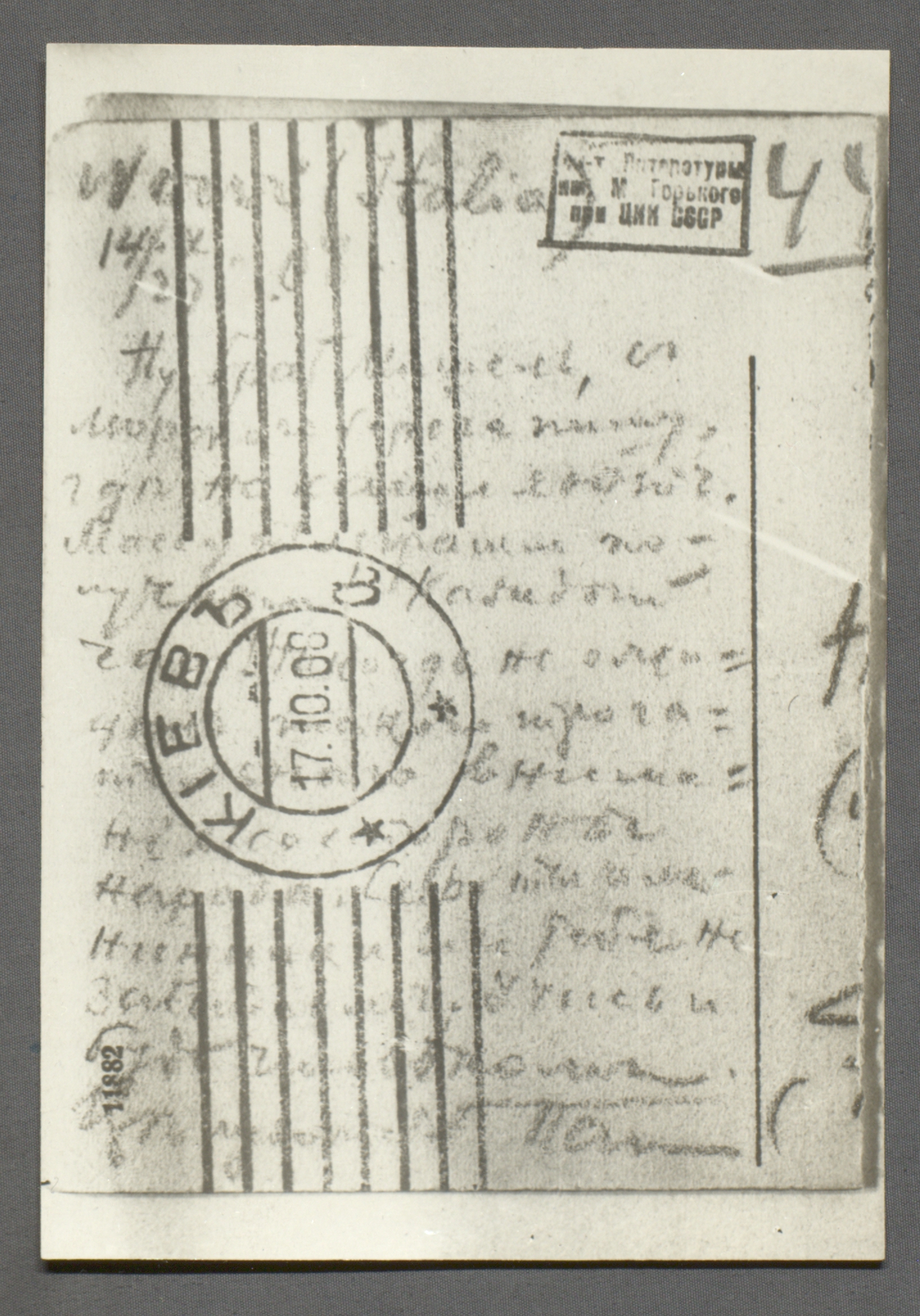
1196-1-20: Letters to the son, Michael (Elimeylekh) Rabinovich (Oct. 14, 1908 – Jan. 10, 1909)

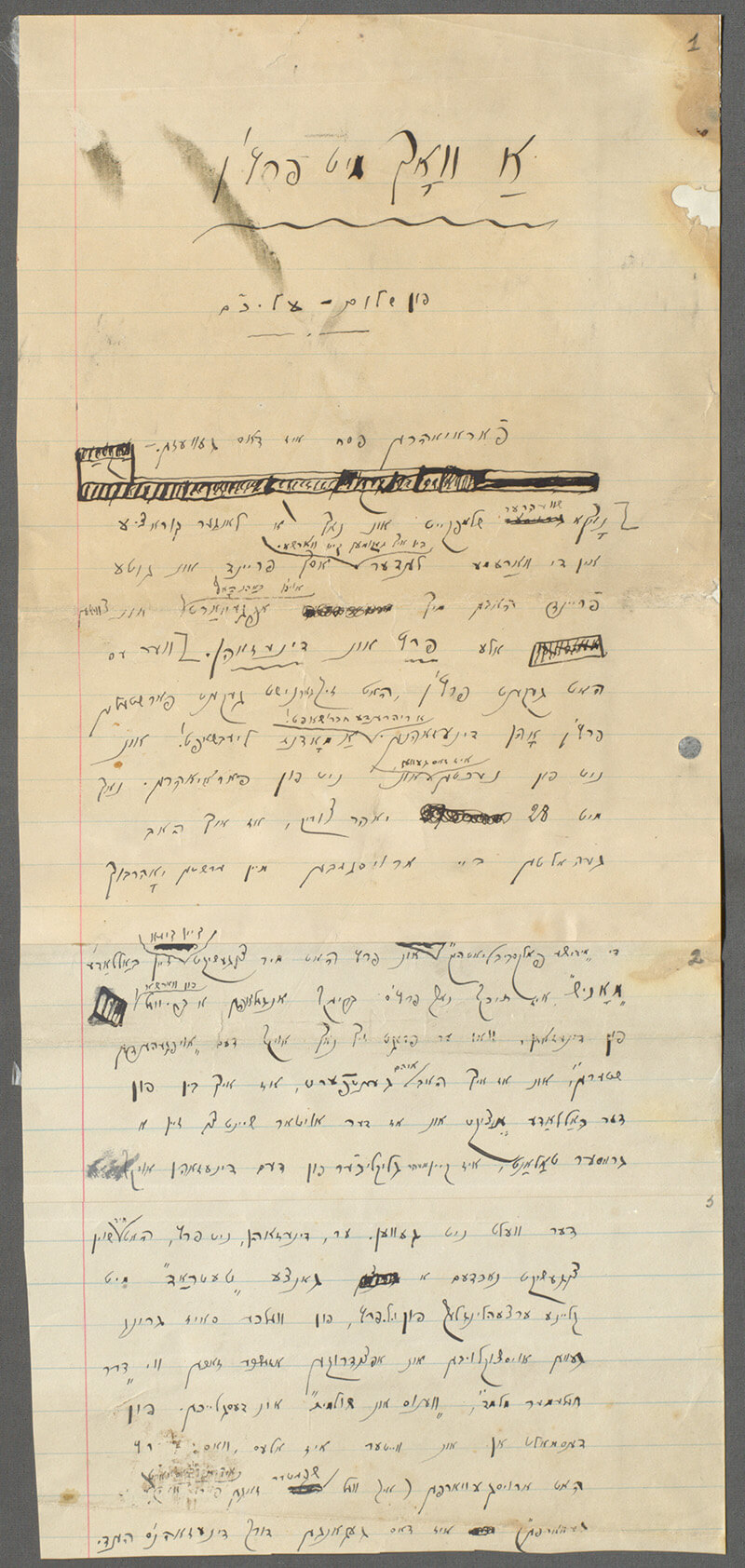
1196-1-17: “A Week with Peretz”, memoirs, f. 4 missing

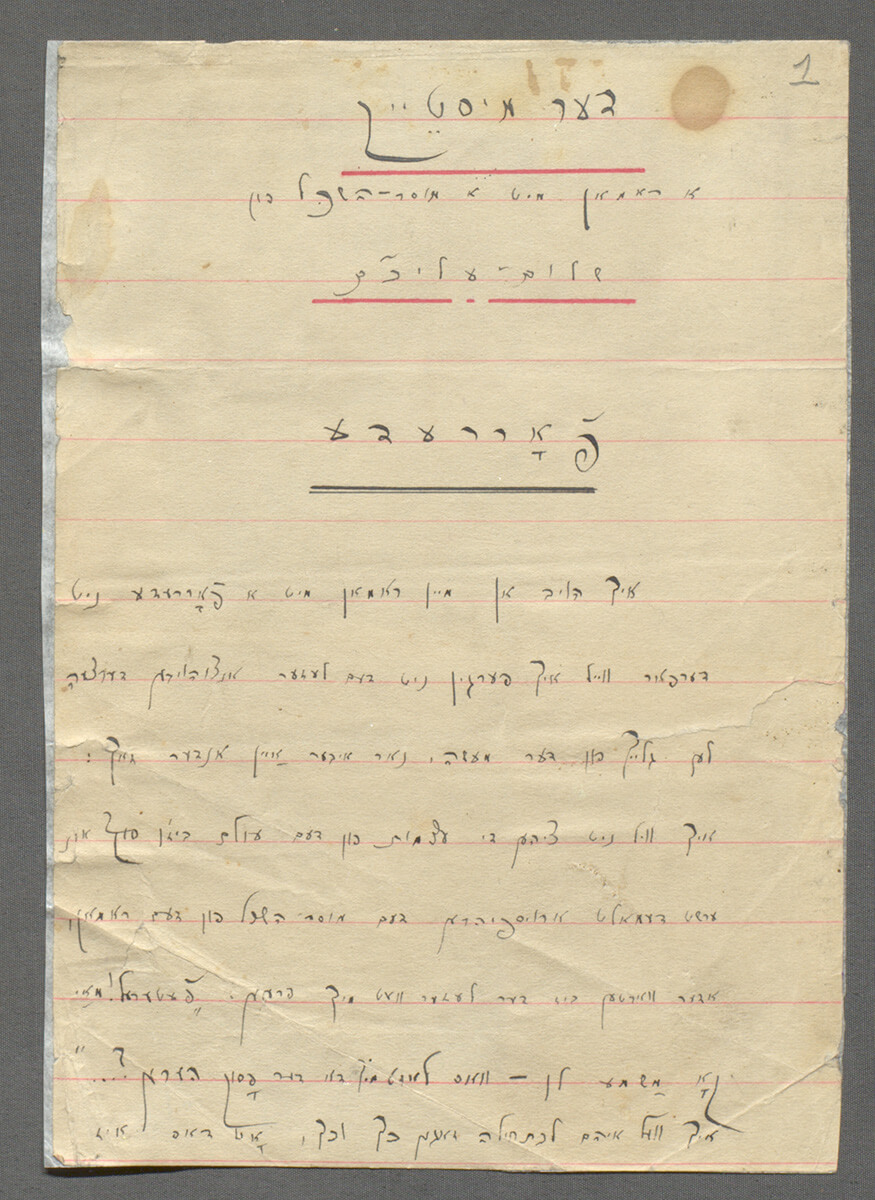
1196-1-16: “The Mistake”, novel, ch. 1-4, 6-8, author’s foreword

1196-1-14: “1,101 Nights Stories”, ch. 4, 5, 6, 7, 8

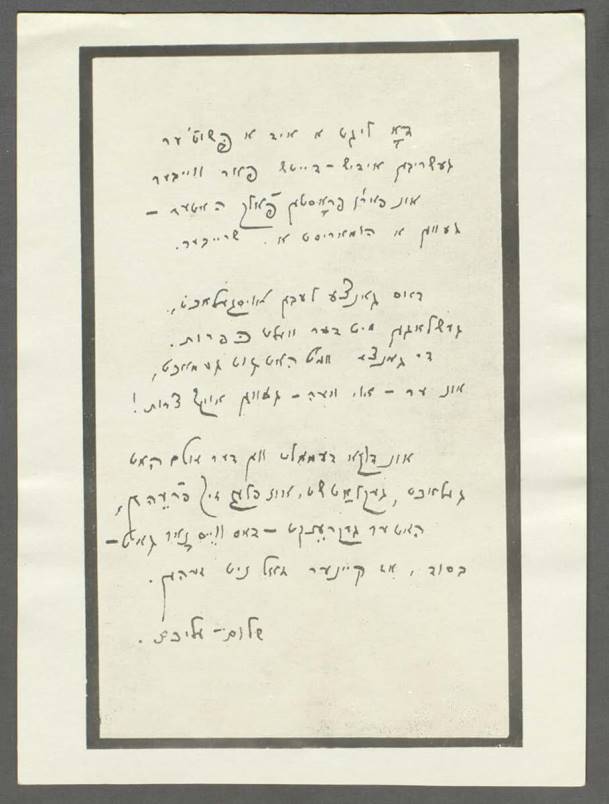
1196-1-11: The Epitaph (poem)

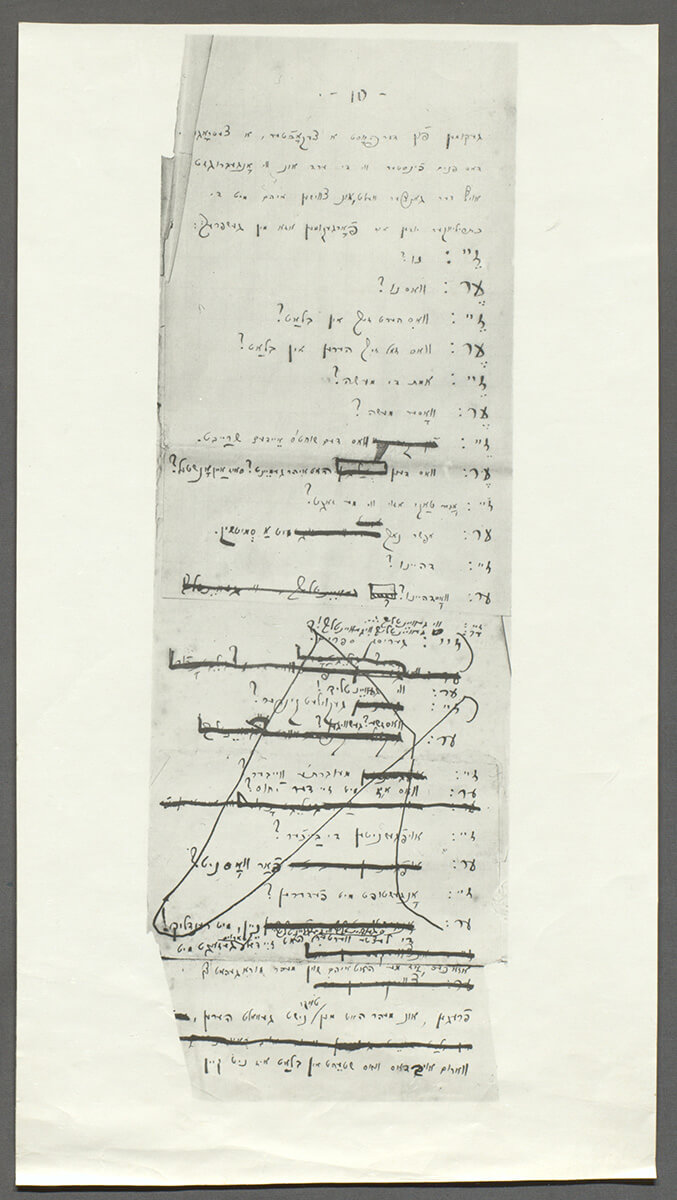
1196-1-9: Presumably, an excerpt from a draft version of the story “The Great Panic of the Little People”

Yitskhok Leybush Peretz

Yitskhok Leybush

Peretz

The Messenger

(book, in Yiddish)

The Itinerary

(book, in Yiddish)

Stories of a Log

(book, in Yiddish)

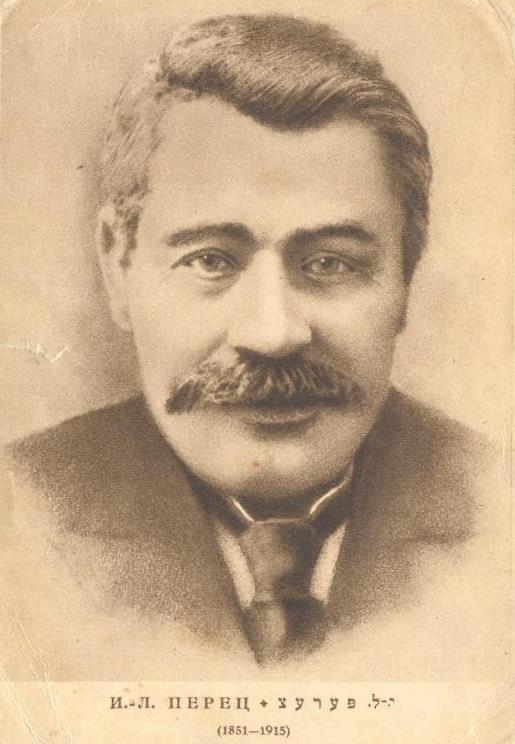
Yitskhok Leybush Peretz is one of the three classics of modern Yiddish prose, along with Mendele Moykher-Sforim and Sholem Aleichem. He was born in 1852 in the city of Zamość (Poland; then the Kingdom of Poland). Besides Yiddish and Hebrew, he was fluent in Polish, German and Russian. 

Unlike the other two classics, Peretz did not live in the Russian Empire and was not much influenced by its literature. His main source of inspiration was the literary world of Western Europe. His first publications were in Polish, then in Hebrew. Yiddish became the main language of his work relatively late, starting from 1888. 

As an author of vivid romantic works infused with elements of mysticism, Peretz may be considered a forerunner of the world famous Nobel Prize winner Yitskhok (Isaac) Bashevis-Singer. Peretz’s two collections of short stories, Khsidish (Hasidic tales) and Folkstimlekhe geshikhtn (Folkloric tales), his plays Baynakht oyfn altn mark (“At Night at the Old Marketplace”) and In polish oyf der keyt (“Chained in the Synagogue Antechamber”), as well as his poem Monish, had a tremendous impact on the further development of Yiddish literature and theater.

During his lifetime, Peretz had already become one of the symbols of modern Yiddish literature. When he died in 1915 in Warsaw, many thousands gathered at his funeral. Streets named after Yitskhok-Leybush Peretz exist in several cities of Israel (Tel Aviv, Haifa, Hod haSharon, Bat Yam, Holon, Kiryat Yam, Giv’at Shmuel) and Poland (Warsaw, Zamość, Kutno, Wrocław). There is also Peretz Square named after him in Lower Manhattan, New York.

Mendele Moykher-Sforim

Mendele

Moykher-Sforim

About Mendele Moykher-Sforim

(in Russian)

Sholem-Yankev Abramovich known by his pseudonym Mendele Moykher-Sforim is considered a classic of prose in two Jewish languages, Yiddish and Hebrew, as well as a pioneer of several genres of modern Jewish literature. He was born in 1836 in the town of Kopyl, known in Yiddish as Kapulye (Minsk Governorate of the Russian
Empire, now Belarus), but spent most of his life in Ukraine.

In 1867, Abramovich published a collection of Hebrew articles titled Eyn Mishpat (“Critical View”), which essentially laid the foundation for Jewish literary criticism. He also laid the foundations of the modern literary styles in both Hebrew and Yiddish. His short novel Di klyatshe (“The Nag”) was, perhaps, the first literary work in
Yiddish that attracted the attention of non-Jewish readers. The Russian poet Ivan Bunin translated it into Russian in 1880, and the Polish writer Klemens Junosza (Szaniawski) – into Polish in 1886.

Abramovich, later to be known simply as Mendele, began his literary career in Hebrew. His first work in Yiddish, the short story Dos kleyne mentshele (“A Little Man”) was published in 1864 in the newspaper Kol Mevaser. At that time, the Maskilim, adherents of the Jewish Enlightenment movement known as Haskalah, exhibited scornful attitudes towards Yiddish. Mendele’s work in this language deemed too elitist to many, supposedly unsuitable for the poorly educated audience who could not read neither Hebrew, nor Russian, German or Polish.

But it was precisely this “elitism” that turned his prose into a foundational successful experiment, on which all the subsequent masterpieces of Yiddish prose were based. For this reason, Sholem Aleichem called Mendele Moykher-Sforim “the grandfather of Yiddish literature”. Two novels are considered his most important works: Masoes
Binyomin ha-Shlishi (“The Travels of Benjamin the Third”) and Fishke der krumer (“Fishke the Lame”, later translated into English as “The Light Ahead”, for the 1939 film based on this novel).

Mendele Moykher-Sforim died in 1917 in Odessa, where he had lived for many years. Streets named after him exist in several Israeli cities, including Jerusalem, Tel Aviv, Herzliya, Kiryat Yam, Ra’anana, Bat Yam, Rehovot and Holon.

Hayim Nahman Bialik

Hayim Nahman Bialik

Hayim Nahman Bialik in Yiddish Poetry

(Russian essay by Velvl Chernin)

Songs and Poems

(book, Russian translation by Vladimir Zhabotinsky)

The poet Hayim Nahman Bialik (1873–1934) is best known as a classic of modern Hebrew literature and its symbol, as much as Sholem Aleichem has become the symbol of Yiddish literature. However, besides Hebrew, Bialik also wrote in Yiddish (Sholem Aleichem, by the way, also occasionally wrote in Hebrew).

Bialik’s Yiddish works were an important stage in the general development of poetry in this language. His first Yiddish poem was Oyfn hoykhn barg (“On the High Mountain”), published in August 1899 (Elul 5659 according to the Jewish calendar) in the Krakow Zionist Yiddish weekly newspaper Der Yud.

After this early publication, his Yiddish poems regularly appeared in periodicals for about a decade, mainly in the same weekly Der Yud and in the popular St. Petersburg Yiddish newspaper Der Fraynd. Shortly before the Czernowitz Conference in 1908, at the time when the conflict between the Yiddishists and Hebraists was escalating, the editors of Der Fraynd took an unambiguously Yiddishist stance.

Four books of Bialik’s collected Yiddish poems appeared during his lifetime:

1. Fun tsar un tsorn (“On Sorrow and Anger”), published in 1906.

2. Poezye (“Poetry”), published in 1913.

3. Lider (“Poems”), published in 1918.

4. Shirim (“Poems”), published in 1922.