Sholem Aleichem. Collected Writings
Sholem Aleichem.
Collected Writings
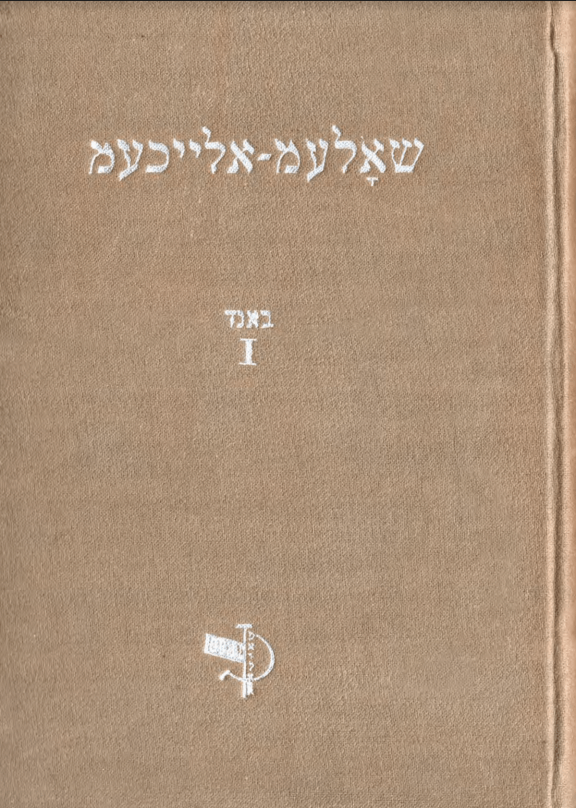
Sholem Aleichem. Volume 1 (Yiddish)
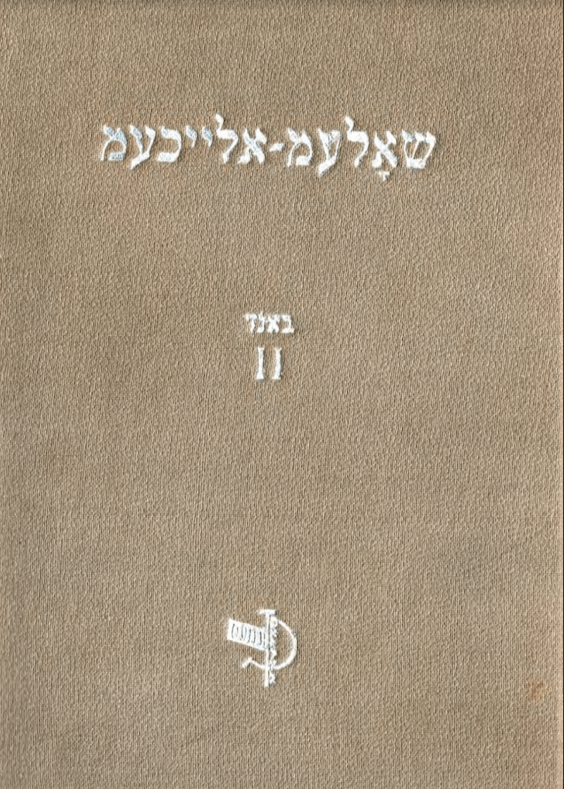
Sholem Aleichem. Volume 2 (Yiddish)
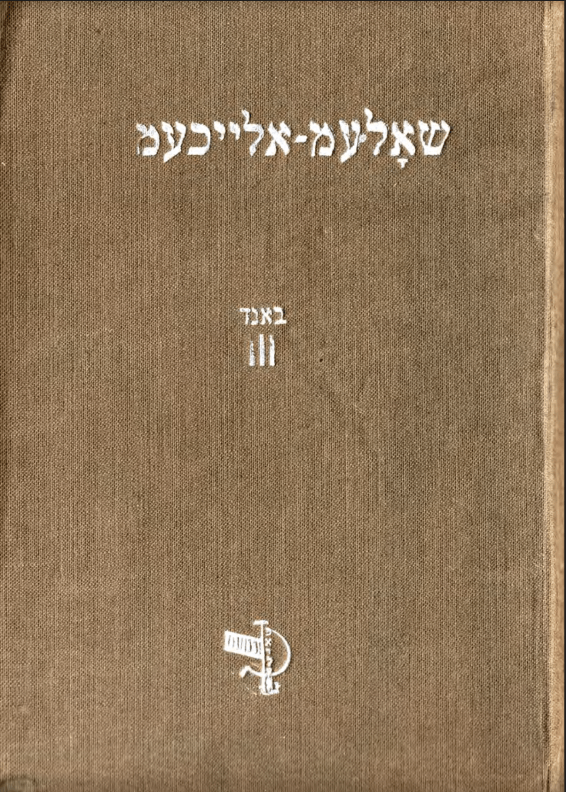
Sholem Aleichem. Volume 3 (Yiddish)
Sholem Aleichem. Volume 1 (Yiddish)
Sholem Aleichem. Volume 2 (Yiddish)
Sholem Aleichem. Volume 3 (Yiddish)
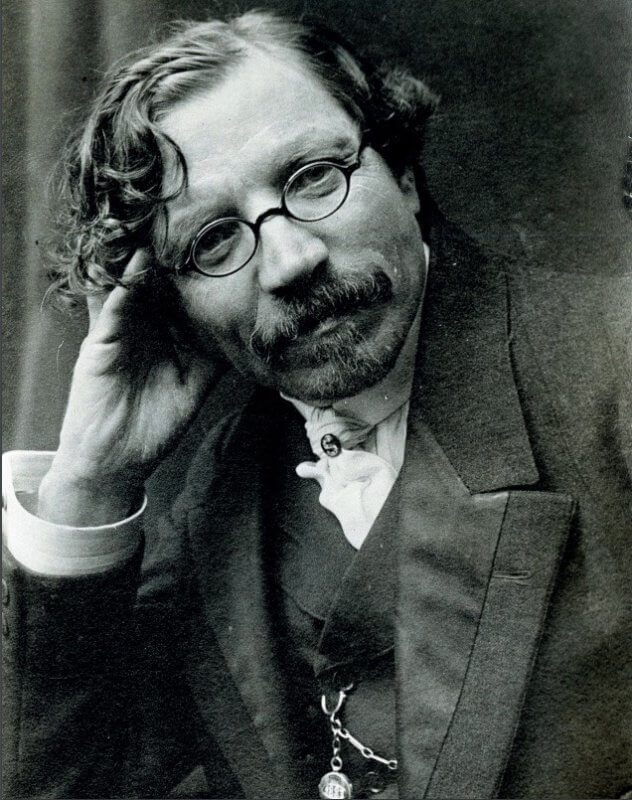
Sholem Aleichem has become known as the most important symbol of Yiddish literature. To some degree, it is due to the fact that, unlike the other two classics of Jewish prose, namely Mendele Moykher-Sforim and Yitskhok Leybush Peretz who wrote both in Hebrew and Yiddish, the language of Sholem Aleichem’s works was almost entirely Yiddish. One should also not forget that he was the least “elitist”, the most “democratic” of our three classics.
The vivid and incredible images of Tevye the Dairyman, the luftmensch Menachem-Mendl, Yossele Solovey, the villages of Kasrilovka, Anatovka and others, all created by Sholem Aleichem, were widely portrayed on the stage and on the screen – not only in Yiddish, but also in Hebrew, Russian, English and many other languages. Few writers can compete with Sholem Aleichem in the number of languages into which their works have been translated.
In the Soviet Union, each national minority was entitled to a literary classic (sometimes two), and such a classic served as the main symbol of that respective people’s literature and culture in general. The works of the national minority’s classic author had to be translated into Russian and other major languages of the USSR. The Georgians had Shota Rustaveli as their classic author, the Ukrainians – Taras Shevchenko, the Belarusians – Yanka Kupala and Yakub Kolas, and the Jews, correspondingly, Sholem Aleichem. Several decades ago, the six-volume collection of his works translated into Russian adorned almost every Jewish home in the USSR.
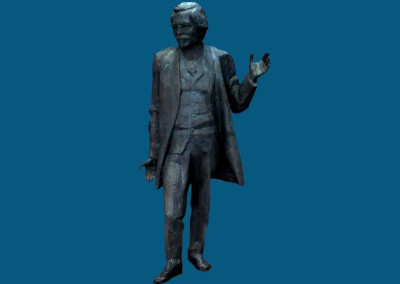
Streets of many cities in the world, from Birobidzhan to Jerusalem, bear the name of Sholem Aleichem. Even a crater on the planet Mercury was named after him. In some cities of Russia, Israel and Ukraine, monuments were erected in his honor. However, there is still no complete academic edition of his works. Such a publication could by no means appear in the USSR, since quite a few of Sholem Aleichem’s works did not correspond to the Soviet ideological guidelines. One such example is his novel “The Bloody Hoax”, which deals with the blood libel and the lack of legal rights for the Jews in the Russian Empire.
The Soviet citizens were also not supposed to know of Sholem Aleichem’s sympathy for Zionism, of the fact that he participated in two Zionist congresses and wrote a number of journalistic and literary works with explicit Zionist content. However, such a publication, for a number of reasons, has never been produced outside the USSR either, although it would seem that the significance of this writer for Jewish literature is so great that such a project should have started to be undertaken within the century following his death.
Undoubtedly, the compilation of a complete academic collection of Sholem Aleichem’s heritage, which would include all his works, literary, journalistic, and epistolary, some of which were written not only in Yiddish, but also in Russian and Hebrew, would be a difficult task. It would require a large-scale, attentive and painstaking collection of materials. Their publication would also require developing a standardized spelling system. An academic edition would necessarily need to include an apparatus of linguistic, historical and bibliographic commentaries.
An equally important task is to popularize the great writer’s oeuvre, which retains its significance and relevance even now, in the 21st century, despite the fact that the world of the shtetl he describes has now become merely history. In order to popularize such a writer one must thoughtfully create a bridge between his bygone world and the modern realities.
Why do these two tasks need to be put forward, if we wish to immortalize our classic’s legacy? The answer may be found in Sholem Aleichem’s own Testament, where, in particular, he wrote: “For me the best monument would be for my works to be read and for there to be, among the wealthy classes of our people, patrons who wish to publish and disseminate them, both in Yiddish and in other languages… If I did not merit or deserve to have patrons during my lifetime, then – maybe – I will have the merit to have them after death.”
Yiddish literature (called simply “Jewish literature” in Soviet Russian terminology) is a unique cultural phenomenon. It is simultaneously an integral part of the common Jewish multilingual literary heritage, as well as one of the major European literary traditions. Although its millennia-old background is rooted in the ancient Middle East, Yiddish literature as such is a product of post-medieval Europe.
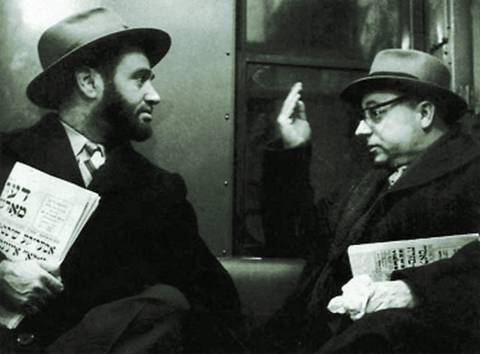
In the American subway of the 1930s
In the wake of the traditional Jewish internal bilingualism, Yiddish literature is organically intertwined with the classic works written in the ancient Hebrew and Aramaic languages. Considered a sacred tongue, Hebrew functioned in the traditional Jewish society as a supreme language associated with the religious domain and religiously flavored literary genres, such as liturgical poetry, piyyut. Due to this bilingualism, Yiddish literature developed specific means of expression. For example, a Yiddish text may contain entire quotations from Hebrew or Aramaic religious sources followed by their translation into Yiddish, creating the impression of a sudden downfall from a higher to a lower style. At the same time, deliberately inexact translations may be used to create a comic effect. A great example of this technique is the onset of Sholem Aleichem’s well-known story The Enchanted Tailor. In order to demonstrate this literary technique, we will try to imitate it by using some Latin expressions and pseudo-archaic words.
“Vir erat in terra Zelodeia” – there was a man who lived in Zlodeyevka, a shtetl in the vicinity of Mazepovka, near Chaplapovich and Kozodoyevka, between Yampol and Strische, precisely on the road that leads from Pishi-Yabeda through Pechi-Chvost to Teterevetz and then ultimately to Yehupetz.
“Et erat nomen eius Simeon Elias” – and he was called Shimen-Elie, and he was also called “Shimen Elie Audi Vocem” by virtue of his habit to alway shout loudly during worship at the synagogue, expressing his great passion by the cracking sound of his knuckles, roaring, crooning and giving utterances by astonishing bawling.
“Et ille homo erat vestiarius” – and the man was a tailor, not a top-tier tailor, heaven forfend, of those who tailor cloths according to a “tabletier” otherwise known as “journal”; nay, that man was simply a patchman, namely a grandmaster of laying patches.
Chronologically, Yiddish literature may be divided into “old” (before the beginning of the 19th century) and “new”. In comparison to many other European literary traditions of the same time period (e.g. premodern Russian literature), old Yiddish literature is sufficiently rich. Among its diverse genres and numerous works are prozaic and poetic rerenderings of biblical texts, fairy tales, Jewish-themed adaptations of chivalric romances, memoirs, Purimshpils, travelogues, hagiography of saintly Jews. Due to the high literacy rate among both Jewish men and women, these works targeted a broad audience. At first they were distributed in manuscripts; printed Yiddish books appeared in the 16th century. For example, Elia Levita’s Bove-Bukh, a rhymed and Jewish-flavored version of a medieval chivalric epic, was written in 1507-1508 and printed in 1541. The development of Yiddish publishing helped to erase local dialectal differences in writing and to form a relatively uniform literary style.
The appearance of the new Yiddish literature was a direct result of social modernization of Europeans Jews and the activity of the Haskalah (Enlightenment) movement. Adherents of this movement who became the progenitors of this new literature include Isaac Baer (Yitskhok-Ber) Levinsohn (1788-1860), Shloyme Ettinger (1803–1856) and Avrom-Ber Gotlober (1811-1988). The new Yiddish literature gained broad popularity thanks to such prolific writers as Yisroel Aksenfeld (1787-1866) and Ayzik-Meyer Dick (1814-1893).
Despite the emergence of a broad readers’ audience, Yiddish literature fell behind the leading European literatures (e.g. Russian) up until the third quarter of the 19th century. Mendele Moykher-Sforim (1835-1917) whom Sholem Aleichem called “the grandfather of Jewish literature” raised the quality of Yiddish prose to a much higher level. His novel Di klyatshe (The Nag, 1873) attracted the attention of both Jewish and non-Jewish readers (Ivan Bunin translated it in 1890 into Russian). After Mendele Moykher-Sforim, Yitskhok-Leybush Peretz (1852-1915) and Sholem Aleichem (1859-1916) further enriched the quality and content of Yiddish writing. The works of these three authors are rightly considered the classics of Yiddish prose.
In the 1870s, the prominent playwright Avrom Goldfaden (1840-1908) established professional Yiddish theater. Sholem Aleichem and Yitskhok-Leybush Peretz also made significant contributions in the field of Yiddish playwriting.
At first, modern Yiddish poetry lagged behind prose and playwriting. Up until the late 1880s it was dominated by folkloric tendencies represented by the then-popular poets Mikhl Gordon (1823-1890) and Elyokum Zunser (1836-1913). Thanks to Shimen-Shmuel Frug (1860-1916), who also wrote in Russian, Yiddish poetry reached the level of the most developed European poetry traditions. A great landmark in the development of Yiddish poetry was Yitskhok-Leybush Peretz’s poem “Monish”.
Although Frug was recognized as a successful poet, Yiddish was still stigmatized as a “low language”, supposedly unsuitable for “high poetry”. In his poem “My Epitaph”, Frug himself described sharply and painfully his feeling that his high poetic aspirations could not be adequately expressed by the means of his “low language”. This false stereotype was completely shattered by Hayim Nahman Bialik (1873-1934) who is a considered a classic modern Hebrew poet. Although his corpus of Yiddish poetry is relatively small, it is extremely significant. In 1906, his book “On Sorrow and Rage” was published, including a Yiddish version of his Hebrew poem “In the City of Slaughter” (translated into Russian by Vladimir Zhabotinsky) and his exclusively Yiddish poem “The Last Word” (translated into Russian by Samuil Marshak). This book proved once and for all that Yiddish is perfectly suitable for high poetry.
At the beginning of the 20th century, Yiddish literature quickly absorbed and creatively developed all the achievements of European modernism. One of the first Yiddish modernist literary groups, Di yunge (The Young Ones), was founded in the USA before the First World War by a group of Jewish immigrants, including Mani Leib (1883‒1953), Zishe Landau (1889‒1937), Dovid Ignatov (1885–1954) and Moyshe-Leyb Halpern (1886–1932). The Kiev Group, which included Dovid Bergelson (1884‒1952), Dovid Hofstein (1889‒1952) and Leib Kvitko (1890‒1952), appeared during the civil war in Ukraine. The Warsaw group Khalyastre (The Gang), founded in the early 1920s, included Uri-Zvi Greenberg (1896‒1981), Peretz Markish (1895‒1952) and Melech Ravitch (1893‒1976). Another group of Jewish immigrants in New York – Jacob Glatstein (1896‒1971), Aaron Glanz-Leyeles (1889–1966) and Nochum-Boruch Minkov (1898–1958) – formed a movement called In zikh (In the Self).
The first half of the 20th century was a flourishing epoch for all genres of Yiddish literature. It is impossible to include in this short introductory article all the notable authors’ names of this fruitful period. Only a few of them are known to those who can not read Yiddish thanks to translations: Sholem Asch (1880‒1957), Israel Joshua Singer (1893–1944), Kadya Molodovsky (1894–1975), Itzik Manger (1901–1969), Isaac Bashevis Singer (1902–1991), Chaim Grade (1910–1982), Avrom Sutzkever (1913-2010). A detailed history of modern Yiddish literature is yet to be written.
The end of the 20th century witnessed a rapid decrease in the number of Yiddish speakers and writers. Nevertheless, Yiddish literature continues to exist. Some contemporary authors are native speakers, while some others studied Yiddish as a second language in various classes, academic programs or independently. Four times a year the literary magazine Yiddishland is published parallelly in Israel and Sweden. The literary almanac Birobidzhan in Russian and Yiddish appears every year in the Jewish Autonomous Oblast of Russia. The online publication Yiddish Branzhe, based in New York, publishes new materials every month. Fortunately, this list of ongoing publications is far from exhaustive.